Desktop
Responsible packaging for a responsible future
We Make. We Supply. We Deliver
Mobile/Tablet
Responsible packaging for a responsible future
We Make. We Supply. We Deliver
MENU

Desktop
Responsible packaging for a responsible future
We Make. We Supply. We Deliver

Mobile/Tablet
Responsible packaging for a responsible future
We Make. We Supply. We Deliver
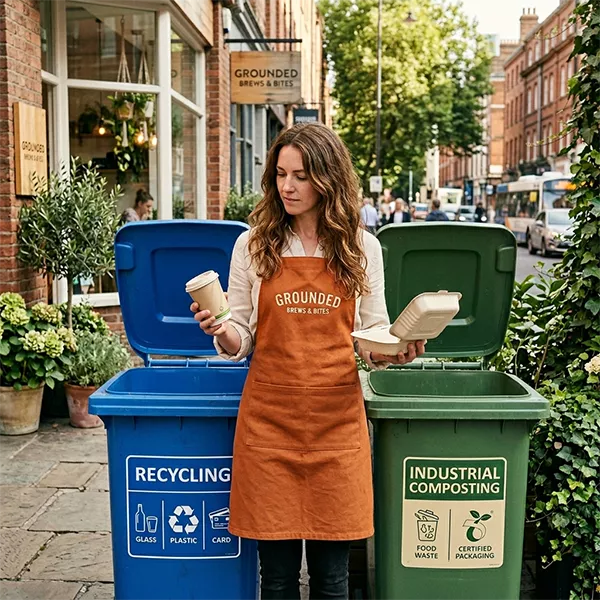
If you run a café, catering operation, or food-to-go business, sustainable packaging is probably already on your radar. Your customers care about it, councils are pushing for it, and legislation is slowly catching up too. But once you start looking into eco-friendly options, the language gets confusing fast.
Compostable, recyclable, biodegradable, plant-based: these terms are often used interchangeably, and they should not be. Each one means something specific, and choosing the wrong option for your setup can mean your "eco-friendly" packaging ends up in landfill just like everything else.
This guide cuts through the noise. We'll explain exactly what compostable and recyclable packaging are, how they differ, what each one actually requires to work, and how to decide which is right for your food business.
Before we get into compostable vs recyclable, let's address the word that keeps popping up everywhere: biodegradable.
Technically, almost everything is biodegradable given enough time. Conventional plastics are not biodegrade, they do break down but it takes hundreds of years and will leave behind microplastics along the way. In the UK, "biodegradable" has no legal definition in a packaging context, which means it can be used fairly loosely.
It is not a certification. It is not a disposal route. It tells you very little about whether packaging is genuinely better for the environment.
Compostable and recyclable, on the other hand, do have defined standards. That is where the real conversation starts.
Recyclable packaging can be collected, processed, and remade into new materials. Rather than being discarded after a single use, the material is fed back into the supply chain, reducing the demand for virgin resources.
Common recyclable materials in food packaging include:
The key phrase there is "depending on your local authority." Recyclability is not universal. What gets collected and processed in one area of the UK may not be accepted in another. This is one of the biggest frustrations with recycling as a system: it relies on infrastructure that varies enormously across the country.
Recyclable packaging needs to be:
Each step is a potential point of failure. Contamination, lack of local facilities, and market economics all affect whether a recyclable material actually gets recycled. A recyclable cup lid that ends up in general waste achieves nothing.
Recyclable packaging works best when you have some control over disposal, or when your customers are genuinely engaged with recycling. Businesses with back-of-house recycling streams, such as caterers supplying offices or event venues, are well-placed to make recycling work properly.
RPET is a good example of recycled plastic done right. Made from post-consumer plastic bottles, RPET cold cups are both made from recycled material and recyclable at end of life, creating a genuine circular loop.
Compostable packaging is designed to break down completely into organic matter under specific composting conditions, leaving no harmful residue behind. The end product is compost: material that improves soil rather than degrading it.
There are two main types:
This is the most common type you will find in food packaging. Materials certified to EN 13432 (the European standard) or similar must break down within 12 weeks in a controlled industrial composting environment, at temperatures of around 55-60°C.
Common industrially compostable materials include:
The critical point: industrially compostable packaging requires collection by an industrial composting facility. It will not break down properly in your home compost bin, and it will not break down properly in landfill either. It needs heat, humidity, and the right microbiological conditions to do its job.
A smaller but growing category. Home compostable packaging (certified to AS 5810 or similar standards) is designed to break down in cooler, less controlled conditions, at the kind of temperatures found in a domestic compost heap.
These materials take longer to break down (typically 6-12 months) but do not require industrial facilities. They are genuinely more accessible in terms of end-of-life, but the materials are more expensive and the range of available products is still limited.
Compostable packaging really comes into its own when you have a composting collection infrastructure in place. Some councils and waste management services do collect food packaging for composting, particularly in areas with strong commercial composting facilities.
It is also a genuinely good match for food-contaminated packaging. Greasy pizza boxes, used soup containers, and bagasse plates that have been in contact with food are very difficult to recycle (contamination is a major issue in recycling streams). Compostable packaging sidesteps this entirely: the food residue goes into the compost along with the packaging.
| Recyclable | Compostable | |
|---|---|---|
| End of life | Processed back into raw material | Breaks down into organic matter |
| Infrastructure needed | Recycling collection and MRF | Industrial composting facility (usually) |
| Handles food contamination | Poorly (contaminated packaging is often rejected) | Well (food residue composts along with it) |
| UK household bin | Often yes (check locally) | Rarely (most needs industrial composting) |
| Business waste | Depends on your contractor | Depends on your contractor |
| Certification | OPRL, Recycled Content labels | EN 13432, OK Compost, Seedling logo |
| Cost | Generally lower | Generally higher |
This is where food businesses face a specific challenge that general packaging guides often miss.
Packaging that comes into contact with food, whether it is a coffee cup, a burger box, or a soup container, is often contaminated with grease, moisture, and residue. This contamination is one of the main reasons food packaging is harder to recycle than it might seem.
A paper coffee cup that has had coffee in it is difficult to recycle even if it is technically recyclable, because most recycling facilities do not accept contaminated paper. The lining also plays a role: traditional cups use a polyethylene (PE) lining that bonds the plastic to the paper and makes them very difficult to separate during the recycling process. Specialist facilities exist to handle this, but they are not available everywhere.
Compostable packaging handles contamination more gracefully. A bagasse container with food residue, or a PLA cup with residue at the bottom, can go into the composting stream as is. The organic matter breaks down alongside the packaging.
Coffee cups deserve a section of their own, because they are one of the most discussed packaging items in the sustainability space, and there is often genuine confusion about what is available.
Standard single wall cups with a PE lining are recyclable, but only through specialist cup recycling facilities. The UK's cup recycling infrastructure has improved significantly over the past few years, with more recycling points available, but it remains far from universal.
Compostable cups use a PLA lining instead of PE, and are certified for industrial composting. They look and function identically to standard cups in use, but require composting rather than recycling infrastructure at end of life.
The Good Cup takes a different approach entirely. It is a completely plastic-free, one-piece paper cup with no separate lid required. Without a plastic lining, it sidesteps many of the recycling complications of traditional cups and has won numerous awards for its approach to sustainable design.
Each option has merits depending on what waste management infrastructure your business has access to.
There is no single right answer here. The best choice depends on your operation, your customer base, and what waste collection services you actually have access to. A few questions worth asking:
What does your waste contractor actually collect? This is the most important question. It does not matter how well-intentioned your packaging choices are if the collection infrastructure is not in place to deal with them properly. Call your waste contractor and ask specifically whether they accept compostable packaging and whether they have separate food and packaging waste collections.
Are your customers likely to sort their waste? If you have a table service restaurant with proper waste stations, you can influence disposal behaviour. If you are running a market stall or handing out takeaway bags, you have very little control over what happens after your customer walks away.
How much food contact does your packaging have? Heavily contaminated packaging (greasy food containers, used soup cups) is a better candidate for compostable materials. Clean, dry packaging that does not get significantly contaminated, like an outer box or bag, may be a better candidate for recycling.
What is your budget? Compostable materials tend to carry a price premium over standard recyclable alternatives. For businesses with tight margins, this is a real consideration. The good news is that the range of compostable products has grown significantly and prices have come down compared to a few years ago.
Rather than trying to make everything compostable or everything recyclable, most food businesses benefit from a mixed approach:
The goal is not perfection. It is making the best choices available within the constraints of your operation and then being honest with your customers about what those choices mean.
Whichever route you go down, look for packaging that carries proper certification rather than vague marketing language.
For recyclable packaging, the OPRL (On-Pack Recycling Label) scheme is the UK's main standardised system. Look for "Widely Recycled", "Check Locally", or "Recycle" labels.
For compostable packaging, look for the EN 13432 standard, the Seedling logo (issued by European Bioplastics), or the OK Compost Industrial certification from TÜV Austria.
Be wary of terms like "eco-friendly", "green", or "planet-safe" without any certification to back them up. These are marketing words, not standards.
Compostable and recyclable packaging both have genuine environmental benefits, but they are not interchangeable and they are not one-size-fits-all. Recyclable packaging relies on collection and processing infrastructure; compostable packaging relies on composting infrastructure. Neither achieves anything if it ends up in the wrong bin.
For food businesses, the most important thing is to match your packaging choices to the waste management reality of your operation, choose certified products over uncertified claims, and prioritise reducing overall packaging volume wherever possible.
At Zeus Food, we stock a full range of both recyclable and compostable food packaging options, from RPET cold cups and recyclable kraft boxes to bagasse food containers and compostable cup lids. If you are not sure which direction to go, our team is happy to talk through what makes sense for your setup.